


About Survival of the Closest
You can be surrounded by people and still be operating as if everything is on you.
A decision comes up. A difficult conversation. A problem at work. A transition in your life. Something you need to practice, figure out or carry.
And almost automatically, the problem becomes yours.
You think harder. Prepare harder. Organize yourself better. Become more resilient. Try to figure it out.
Sometimes that is exactly the right thing to do.
But sometimes there is another question worth asking:
Why am I assuming this is a Me Problem?
By Me Problem, I don’t mean a particular kind of problem. I mean a problem that I have implicitly assigned to myself to perceive, interpret, decide, practice and carry alone.
Survival of the Closest is a public experiment in what happens when we become more deliberate about that choice.
Sometimes the right answer is to handle something ourselves.
Sometimes one other person is enough.
And sometimes a small group could be useful.
That last possibility is what I’m exploring through The Six.
What is The Six?
The Six is a deliberately designed peer group.
The aim is six people. The same people meet for 90 minutes a week for six weeks. They use simple cards, clear agreements and shared responsibilities rather than relying on a professional facilitator or one permanent leader.
Each meeting has the same basic shape:
Open the Container → Work on Something Real → Carry It Out and Close.
Someone brings a real decision, conversation, challenge or problem into the middle. The group asks questions before jumping to advice. Members may offer perspectives, rehearse a conversation, help make something, connect someone with a resource or simply see something the person could not see alone.
Then everyone leaves with something small to try in ordinary life.
The next week, they bring back what happened.
Practice here → Take it out there → Bring back what happened.
That repeated loop—not content consumption—is the experiment.
The Six is not therapy, crisis care or an obligation to turn every problem into a group problem. Autonomy remains a legitimate choice.
The aim is to have more than one social configuration available to you, and to learn how to create a useful peer environment when a group actually fits.
Why am I doing this?
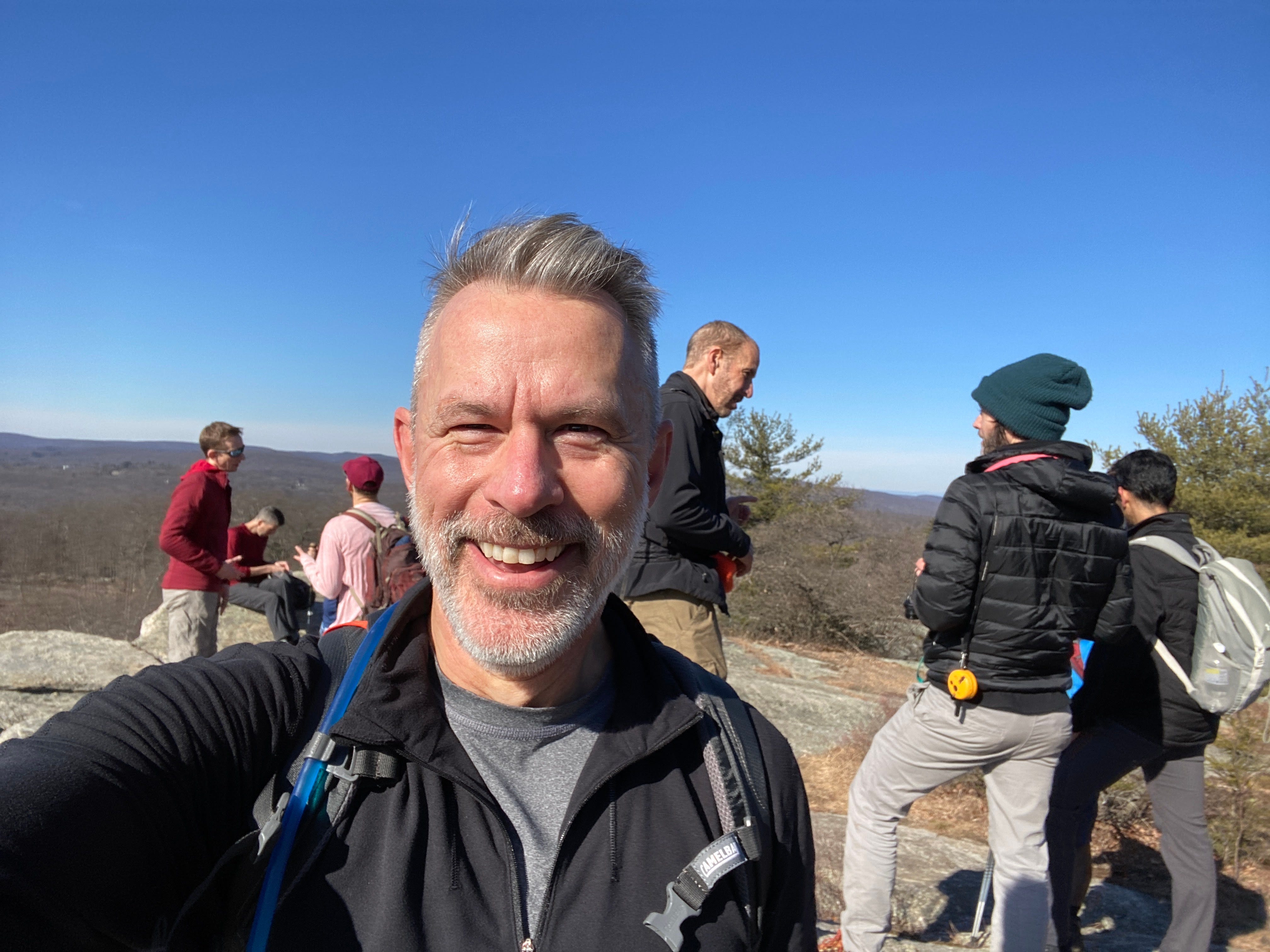
I’m Cliff Atkinson.
For more than 20 years, my professional work has revolved around communication in consequential rooms.
I wrote Beyond Bullet Points and have spent much of my career helping trial lawyers make complicated cases understandable to juries. That work gave me a peculiar vantage point: lawyers spend weeks communicating with twelve strangers, and then eventually leave the room. The jurors have to think together on their own.
Over time, I became as interested in the conditions around communication as in the message itself.
One turning point came while I was teaching a room of roughly 100 lawyers. Instead of accepting the usual stage-and-rows arrangement that is the default setup for rooms like this, I began first by asking everyone to form small groups of about six and talk together first. When we came back together, I built the session around what those groups surfaced.
I had not merely changed the presentation.
I had changed the social environment.
A separate personal thread came from 2½ years of training with Ray Castellino and participating in his small-group workshops. Those experiences left me intensely curious about something much broader:
Can the conditions that make a group useful be deliberately designed, and can ordinary people create those conditions for themselves without depending on an expert to run the room?
The Six is my current experiment with that question. My experiences explain why I’m asking it. They do not prove the answer.
What does the science say?
There are several bodies of research behind the questions I’m exploring, including Social Baseline Theory and predictive-processing research.
But I’m deliberately keeping the science in the background.
One useful clue comes from a 2022 study involving 2,118 U.S. adults. People who needed help tended to underestimate how willing others would be to help and how positively helpers would feel about helping, while overestimating how inconvenienced those helpers would feel.
That does not prove that anyone needs a Six.
It does suggest an interesting question:
What am I predicting will happen if I bring somebody else in, and what actually happens when I test that prediction?
That spirit: prediction, experience, new evidence; is much closer to what Survival of the Closest is about than teaching people a theory.
Why subscribe?
I’m developing this in public rather than pretending I already know the answer.
Here you’ll find stories and ideas about the invisible assumption that we should carry life alone; practical experiments you can try; field notes from the first Sixes; invitations to live events; updates to The Peer-to-Peer Protocol; and guides for finding people and forming a Six of your own.
You’ll also see the failures.
The current Sixes are experiments. We do not yet know who gets the most value, which problems respond best, what causes people to drop out, or whether the practice reliably transfers into everyday life. Those are the questions the first groups are helping answer.
And there is a larger possibility I’m curious about.
If some Sixes become genuinely useful to their members, perhaps some will choose to continue. Perhaps nearby Sixes will occasionally meet, share resources or work together on something that matters where they live.
Maybe nothing like that happens.
For now, the job is much smaller:
Six people. Six weeks. Something real to work on. See what happens.
Subscribe if you want to follow the experiment.
And when you’re ready:
Find Your Six.
Stay up-to-date
Never miss an update—every new post is sent directly to your email inbox. For a spam-free, ad-free reading experience, plus audio and community features, get the Substack app.
